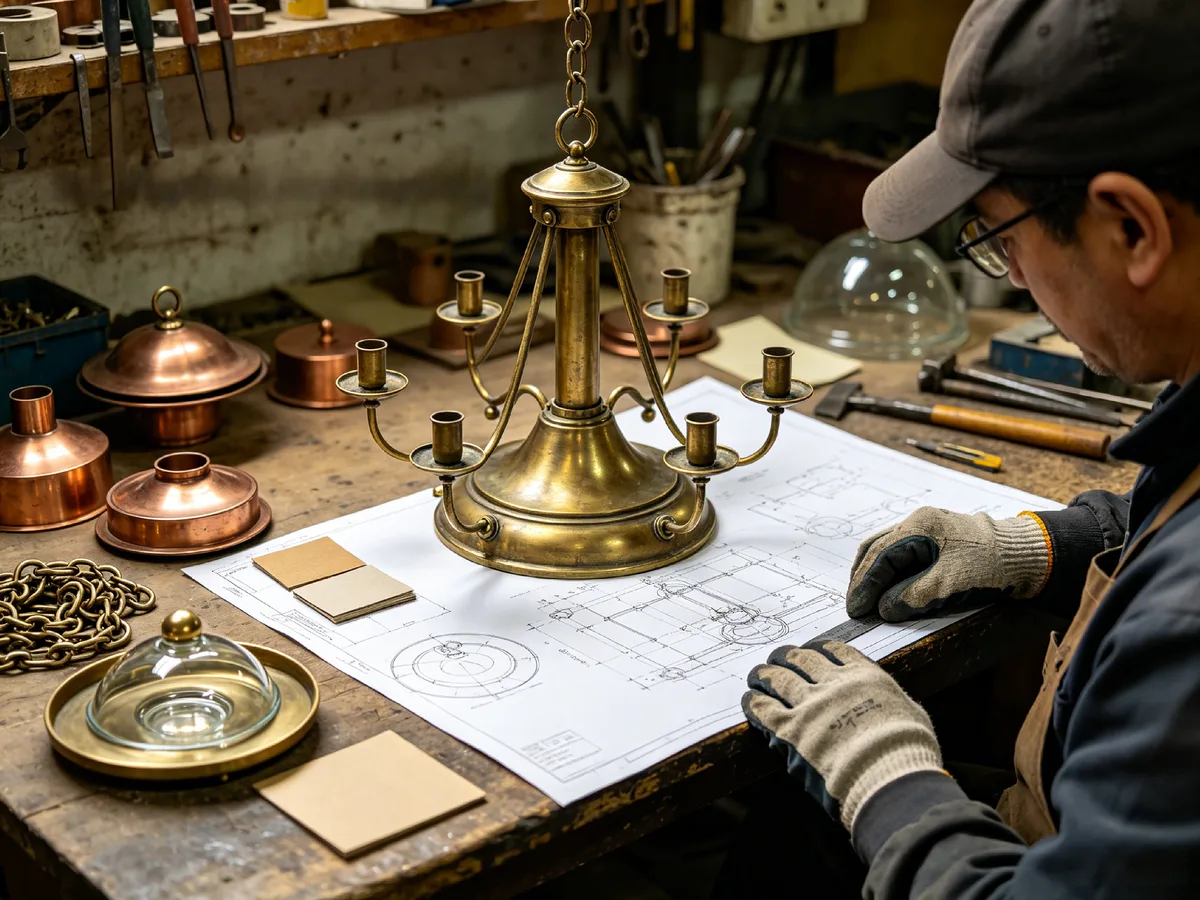
Our copper and brass work begins with hand-welded tube stock, each seam ground flush by hand until invisible to the eye and the touch. Chemical patination then builds tonal depth — darker in the recesses, lighter on raised edges — producing the dimensional quality that separates a genuinely hand-finished bronze from an electroplated imitation.
Why the Finish Matters in Bespoke Bronze Lighting
In five-star hospitality interiors, a bronze chandelier or wall sconce is rarely judged from across the room — it is scrutinised at arm's length by designers, owners, and guests standing directly beneath it. Under that scrutiny, an electroplated "bronze" finish reveals itself: a flat, uniform colour with no depth, no variation, no story. A genuine hand-rubbed bronze finish, by contrast, carries tonal movement across every curve — the unmistakable signature of a human hand.
The Five-Stage Bronze Patination Process
Every bespoke bronze lighting fixture leaving the Metis Maison workshop passes through the same controlled sequence. Nothing is rushed, because patina cannot be hurried — it is a chemical conversation between metal, time, and the artisan's eye.
01 · Hand-Welding the Brass Body
We start with solid brass and copper tube stock, TIG-welded by hand. Each weld seam is ground flush — first with a belt grinder, then by hand with progressively finer abrasives — until the joint disappears entirely under fingertip inspection. This is the structural foundation: a body that will hold a patina evenly must first hold a single, continuous surface.
02 · Surface Preparation & Degreasing
The body is ultrasonically cleaned and hand-wiped to remove every trace of oil, flux, and finger residue. Even a single thumbprint will reject the patina and leave a visible flaw — so the fixture is handled with lint-free gloves from this point forward.
03 · Chemical Patination
This is where the depth is born. A sequence of patina solutions — liver of sulphur, ammonium chloride, and custom blends — is applied by brush and cloth, building colour in layers. The artisan works wet-on-wet, darkening the recesses first, then lifting colour off the high points with a fine abrasive pad. The result is a dimensional bronze: deep umber in the valleys, warm honey on the ridges, with a living transition between them.
04 · Hand-Rubbing & Highlighting
The patinated surface is then hand-rubbed with steel wool and a light wax, selectively removing colour from edges and corners where natural wear would occur over decades. This is the step that gives hand-finished bronze its authenticity — it mimics the way a real antique bronze object ages under human touch.
05 · Sealing & Curing
Two coats of a clear microcrystalline wax — museum-grade, the same family used to conserve bronze antiquities — lock the patina in place and provide a soft, living sheen rather than the plastic gloss of lacquer. The wax is buffed by hand and cured for 24 hours before the fixture moves to electrical assembly.
“Great lighting is not a commodity. It is a statement of identity, shaped by the hands of artisans who understand both the language of design and the demands of the built environment.”
Hand-Rubbed Bronze vs. Electroplated "Bronze"
The difference is not cosmetic — it is structural and archival. An electroplated bronze finish is a thin metallic skin deposited in minutes; it is uniform by design and ages by flaking. A hand-rubbed bronze patina is a chemical transformation of the metal surface itself, micron-deep, and it deepens gracefully with age rather than failing. For hospitality projects expected to last decades, that distinction is the difference between a fixture that looks better in year ten and one that needs refinishing in year three.
- Depth: Patinated bronze carries tonal movement; electroplating is a single flat colour.
- Durability: Patina is part of the metal; plating sits on top and can chip.
- Aging: Hand-rubbed bronze deepens with age; plated bronze degrades.
- Repair: A patinated surface can be locally re-rubbed; a plated surface cannot be spot-repaired.
Six Signature Finishes for Hospitality Lighting
Beyond our hand-rubbed bronze, the Metis Maison atelier offers six signature finishes developed for the hospitality sector — each tuneable to a designer's palette. Our 2026 collection introduces Smoked Bronze and Aged Pewter, alongside the established Brushed Brass, Polished Chrome, PVD, and custom patinas. Every finish is RoHS-compliant and verified under our UL / ETL / CE audited supply chain. Brass follows the same logic as bronze — the colour is either in the metal or on it — and our antique brass buyer's guide sets out the four checks that tell the two apart on a sample.
Engineered for the Built Environment
A beautiful finish means nothing if the fixture fails structurally. Every brass and bronze chandelier we produce is backed by full engineering: SolidWorks 3D models, shop drawings with every weld and load path dimensioned, structural calculations, and a pre-hang load test in our 3,800 sqm workshop before the fixture ever leaves Guzhen. Fixtures over 12 kg are pre-hung with the actual suspension hardware, balanced, and photographed for the client. This is the standard that lets a hand-finished bronze pendant hang safely over a hotel grand ballroom for decades.
Specify Hand-Rubbed Bronze for Your Next Project
If you are specifying bespoke bronze lighting for a hospitality, civic, or high-end residential interior, request a 50×50 mm finish sample chip set — shipped by DHL at cost, refundable against a confirmed order above USD 5,000. For larger architectural finishes we send an A4 sample panel. Every bespoke design moves through our four-step engineering process: concept moodboard, CAD & shop drawings, 1:1 physical prototype, and precision manufacturing with pre-hang test.