The short version
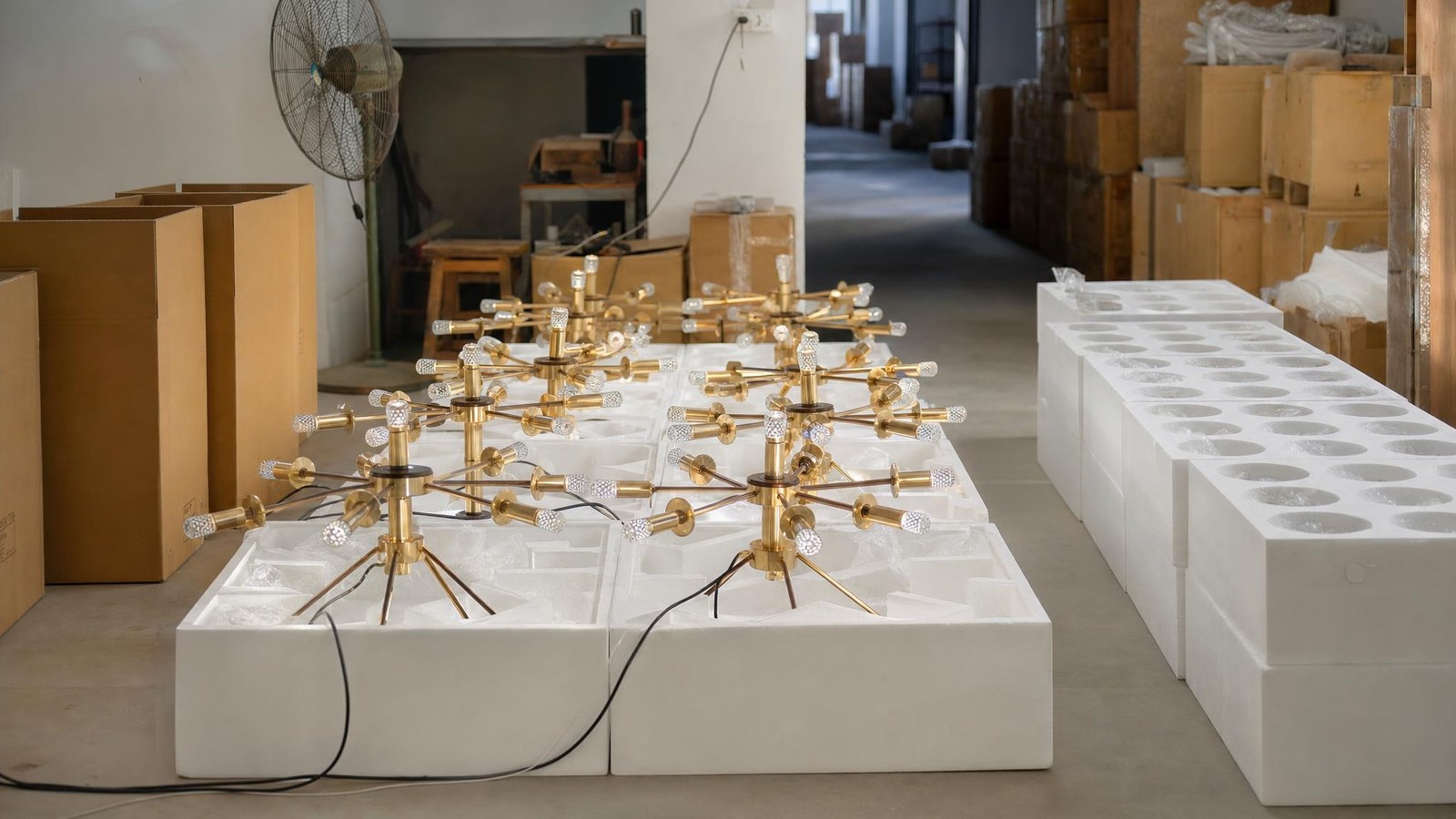
Metis Maison Lighting, founded in 2012 in Guzhen, Zhongshan, lists its materials as SUS304 and SUS316 stainless steel, brass, bronze, aluminium, K9 and K5 crystal, hand-blown glass, alabaster, fabric shades and acrylic, and its finishes as hand-rubbed bronze, brushed brass, polished chrome, PVD, powder coat and custom patinas, with Smoked Bronze and Aged Pewter added in the 2026 collection. All plating is RoHS-compliant. Polishing and assembly happen in its own two facilities in Zhongshan totalling 3,800 m², and every bespoke design is approved on a 1:1 physical prototype before production.
If you searched for metis maison lighting, you are looking for a decorative lighting manufacturer: Metis Maison makes bespoke chandeliers, wall sconces, table lamps and pendants for hotels and other hospitality interiors. It is a different company from Metis Homes, the UK housebuilder. This guide is for lighting designers and FF&E specifiers who need to know what each material and finish on a Metis Maison fixture actually is, where it tends to be the right choice, and what to write into the specification so the approved sample and the delivered fixture match.
Passages marked as general guidance describe standard material behaviour, not Metis Maison test results; everything attributed to Metis Maison reflects what the company publishes about its own materials and process.
What materials does Metis Maison Lighting work with?
The company's published palette covers four groups: structural metals (SUS304 and SUS316 stainless steel, brass, bronze and aluminium), light-transmitting materials (K9 and K5 crystal, hand-blown glass, alabaster and acrylic), soft materials (fabric shades) and a finish list that runs from hand-rubbed bronze to PVD. The table summarises each option, where it is commonly used, and what to pin down before sign-off.
| Material or finish | Typical use (general guidance) | What to specify or approve |
|---|---|---|
| SUS304 stainless steel | Frames, arms and structural parts in dry interior spaces | Grade on the drawing, wall thickness, mill sheet if your standard requires one |
| SUS316 stainless steel | Coastal properties, spas, pool halls and other humid or chloride-exposed zones | Grade per part, matching A4-80 fasteners, the finish over the steel |
| Solid brass | Chandelier bodies, arms and canopies seen at arm's length | Solid or plated, part by part; patina or coating; wax or lacquer |
| Bronze | Decorative elements where a deep, warm metal is wanted | Whether 'bronze' means the alloy or a bronze-coloured finish on brass or copper |
| Aluminium | Larger components where weight matters | Alloy and the finish applied over it |
| K9 / K5 crystal | Prisms, drops and faceted elements that need clarity and sparkle | Grade, cut, clarity under the project's colour temperature |
| Hand-blown glass | Diffusers, shades and pendant globes | Tint, wall thickness range, accepted seeds and variation |
| Alabaster | Wall sconces and shades with a soft, warm glow | Veining range sample, dry-zone location, cleaning method |
| Fabric shades | Table lamps, floor lamps and guestroom sconces | Fabric, colour, flame-retardancy requirement for the market |
| Acrylic | Lightweight diffusers where breakage is a concern | Opal or clear, thickness, distance from the light source |
| Hand-rubbed bronze | Signature public-area pieces seen up close | Approved chip as control sample, accepted tonal range |
| Brushed brass | Warm metallic accents across a scheme | Grain direction, sheen level, sealer |
| Polished chrome | Contemporary interiors and high-gloss details | Substrate, plating thickness, edge coverage |
| PVD | High-touch parts and colours that must stay consistent | Colour reference, substrate, sample on the production base metal |
| Powder coat | Matt or coloured finishes on steel and aluminium | Colour reference, gloss level, texture |
| Custom patina (incl. aged brass, Smoked Bronze, Aged Pewter) | Matching a designer's material palette | Signed chip, tonal range, re-rub method for maintenance |
Stainless steel: when SUS316 is worth specifying over SUS304
As general guidance, SUS304 and SUS316 are both austenitic stainless steels. The practical difference is that 316 contains molybdenum, typically around 2 to 3 percent, which improves resistance to pitting from chlorides. Chlorides come from sea air, pool water, spa treatments and some cleaning products. In a dry lobby, 304 generally performs well; by the sea, around a pool or in a spa, 316 is the safer specification, because pitting shows first on polished surfaces.
Metis Maison lists SUS304 and SUS316 as marine-grade options with wall thicknesses of 1.5 to 3 mm, and specifies fasteners to ISO 898 grade 8.8 as a minimum, with A4-80 stainless fasteners for coastal sites. A4 is the ISO designation for the 316 family of stainless fasteners, so on a coastal job the bolts match the steel they hold. Mill sheets for steel are available on request.
Coastal and humid sites
Specify the grade per part, not per fixture, and make sure fasteners, threaded rod and canopy hardware follow it. As general guidance, dissimilar metals in contact in a damp location can corrode faster at the joint, so ask how brass and stainless parts are separated where they meet.
Brass and bronze: what is in the metal and what is on it
Metis Maison builds its chandelier bodies from solid brass and copper tube stock, TIG-welded by hand and ground flush until the seam cannot be found by fingertip. The colour on these bodies is a chemical patina worked into the metal and sealed under microcrystalline wax rather than lacquer, so the surface can be re-rubbed by hand rather than replaced. Antique and aged brass effects are produced as custom patinas, not as separate stock finishes.
The word bronze needs care on any schedule. Metallurgically, bronze is a copper alloy in its own right, and the company lists it as a material. Hand-rubbed bronze, though, is a finish: the company describes it as a patina built on brass and copper. A schedule that just says bronze leaves the question open; antique, aged and vintage brass likewise name a colour, not a material. Metis Maison publishes the wording it suggests buyers send to any supplier; for each part of the fixture, ask for:
- Whether the body, arms, canopy, backplate, bobeches and visible hardware are solid brass, brass-plated or another material.
- For any plated part, the base metal and the plating thickness in microns.
- Whether the finish colour is a chemical patina on the metal itself or a coating applied over it.
- Whether the sealer is a lacquer or a wax.
- A 50 × 50 mm finish chip produced on the same base metal as the production part.
Mixed construction is normal and honest: a solid brass body with plated steel hardware is a sound way to build a fixture. What matters is that the answer is in writing and filed with the project. On a sample, a magnet and the weight in the hand are useful first checks: brass is non-magnetic and runs around 8.5 g/cm³ on published constants, against roughly 6.6 for die-cast zinc alloy.
How Metis Maison builds a hand-rubbed bronze finish
The company documents a five-stage sequence for its hand-rubbed bronze:
- Hand-welding: solid brass and copper tube stock is TIG-welded, and each seam is ground flush, first with a belt grinder and then by hand with progressively finer abrasives.
- Preparation: the body is ultrasonically cleaned and hand-wiped to remove oil, flux and finger residue, then handled only with lint-free gloves.
- Chemical patination: solutions including liver of sulphur, ammonium chloride and custom blends are applied by brush and cloth, darkening the recesses first.
- Hand-rubbing: steel wool and a light wax lift colour from edges and corners where natural wear would occur.
- Sealing: two coats of clear microcrystalline wax are buffed by hand and cured for 24 hours before electrical assembly.
For a specifier, the consequence is about maintenance as much as appearance. A patina is part of the metal, so wear exposes more brass and the surface can be locally re-rubbed on site with the same steel wool and wax. A plated surface cannot be spot-repaired once the base metal shows. On one hotel project, the company paired hand-rubbed bronze ballroom pendants with hand-blown glass diffusers, while the restaurant's sconces and table lamps used a custom aged-brass patina tuned to the interior designer's palette.
Polished chrome, PVD and powder coat: applied finishes
As general guidance, these three finishes sit on top of the metal rather than changing it. Polished chrome is electroplated from a liquid bath, and like all electroplate it is thinnest where the geometry is sharpest. PVD (physical vapour deposition) is applied in a vacuum chamber as a very thin, hard film; it is generally more abrasion-resistant than decorative electroplating. Powder coat is a dry powder applied electrostatically and baked, giving matt, satin or coloured finishes, most often on steel and aluminium.
Metis Maison lists polished chrome, PVD and powder coat alongside its patinas, and states that all of its plating is RoHS-compliant. The company is open about where plating is the right call: parts mounted out of reach never meet a hand or a cloth, short-life installations such as sales galleries and show flats do not need twenty years, and on large arrays where cost per piece governs, plating over a die-casting is often what makes the scheme buildable.
Plated is fine; mislabelled is not
The problem is not plating, it is plating sold as solid brass. If a quotation describes a fixture as brass, ask for the part-by-part breakdown above before you compare prices.
Crystal and glass: K9, K5 and hand-blown
Metis Maison works with K9 and K5 crystal and describes its K9 as hand-cut optical crystal. As general guidance, K9 and K5 are Chinese optical-glass grade designations, and K9 is the grade most often used for chandelier prisms and drops because of its clarity and the way it takes a polished facet. What to approve is the cut, the clarity of a sample piece under the project's colour temperature, and the cleanliness standard on delivery.
Hand-blown glass is a different brief. Each piece is formed by a glassblower, so small variations in wall thickness and tint, and the occasional seed (a tiny bubble), are part of the material rather than defects. Agree the accepted range on the prototype. For shipping, the company packs glass and crystal parts in individual sleeves inside foam-cradled crates with silica-gel desiccant and a humidity indicator card, in ISPM-15 compliant outer cases.
Alabaster, fabric shades and acrylic
Alabaster appears in the company's 2026 collection, which includes 30 new wall sconce references in brass, bronze and alabaster. As general guidance, alabaster is a soft, translucent natural stone that diffuses light warmly and shows veining that varies from block to block. It is softer and more porous than marble, so it suits dry interior positions away from splashing water and is best cleaned with a dry or barely damp cloth rather than chemical cleaners.
Fabric shades are standard on table lamps, floor lamps and guestroom sconces; the specification should name the fabric and colour and state the flame-retardancy requirement for the destination market. Acrylic is lighter and less prone to breakage than glass, which makes it useful for large diffusers or high positions, but as general guidance it can discolour if placed too close to a heat source, so check the distance from the light source on the drawing.
Natural materials need a range, not a single sample
For alabaster, hand-blown glass and every patina, approve a range: the lightest and darkest acceptable pieces, or a chip set showing the tonal spread. Keep the signed samples on file as the control that production is checked against.
How finishes are sampled and approved
Metis Maison sends finish chip sets at 50 × 50 mm, plus small material samples, by DHL at cost. For larger architectural finishes it ships an A4 sample panel. The sample cost is refundable against a confirmed order above USD 5,000. Combined with the company's published process, the approval route runs:
- Concept moodboard: the designer's concept translated into a material palette, finish swatches and reference imagery, signed off before any drawing starts.
- Finish chips and panels: compared under the project's lighting and kept as control samples.
- CAD and shop drawings: materials and finishes called out part by part.
- 1:1 physical prototype: every bespoke design is approved for finish, proportion and optics on a full-size piece.
- Largest fixture first: for hospitality projects, a full-scale sample of the largest fixture in the package is signed off by the designer and owner before production tooling is released.
- Production: checked against the signed samples, with polishing and assembly in the company's own facilities.
Where the work happens
Polishing and assembly take place in Metis Maison's own two facilities in Zhongshan, totalling 3,800 m². Final assembly is not outsourced; a small share of metal casting comes from a long-term partner mill under the company's QC supervision, with its certificate chain on file.
What to write into a Metis Maison lighting specification
A short checklist removes most of the ambiguity before the first chip is cut:
- Material per part, including stainless grade (SUS304 or SUS316) and fastener class.
- Solid or plated for every brass part, with base metal and plating thickness where plated.
- Finish name plus a signed chip or panel reference, and whether it is a patina, plating, PVD or powder coat.
- Sealer type: wax or lacquer.
- Accepted range for natural and hand-made materials.
- Crystal grade and cut, glass tint, and alabaster positions away from wet zones.
- Documentation: mill sheets for steel, brass and crystal on request, and model-specific test reports once the project is confirmed.
Finish choice also feeds into the warranty conversation. Metis Maison states a five-year warranty on the fixture body, plating and LED modules and two years on drivers and electrical components, honoured through the company or a designated local agent. RoHS 2.0 is model-tested, and the RoHS, CE-LVD, UL and ETL certificates are held by the company's audited partner factory, with original PDFs released under NDA.
Frequently Asked Questions
Metis Maison lists SUS304 and SUS316 stainless steel, brass, bronze, aluminium, K9 and K5 crystal, hand-blown glass, alabaster, fabric shades and acrylic. Its finishes are hand-rubbed bronze, brushed brass, polished chrome, PVD, powder coat and custom patinas, with Smoked Bronze and Aged Pewter introduced in the 2026 collection.
No. Metis Maison is a bespoke hospitality lighting maker based in Guzhen, Zhongshan, founded in 2012, producing chandeliers, wall sconces, table lamps and pendants. Metis Homes is a UK housebuilder; the two are different companies.
As general guidance, yes, for any part exposed to sea air, pool water or spa humidity, because the molybdenum in 316 improves resistance to chloride pitting. Metis Maison offers both grades and specifies A4-80 stainless fasteners for coastal sites, so ask for the grade on every part, including the hardware.
No. The company describes it as a chemical patina built on solid brass and copper tube stock, hand-rubbed and sealed with two coats of microcrystalline wax. Because the colour is part of the metal, worn areas can be re-rubbed locally rather than re-plated.
Yes. Metis Maison sends 50 × 50 mm finish chip sets and small material samples by DHL at cost, and A4 sample panels for larger architectural finishes. The sample cost is refundable against a confirmed order above USD 5,000.
The company states that all of its plating is RoHS-compliant. RoHS 2.0 (EU 2015/863) is model-tested and the certificate is held by its audited partner factory; the model-specific report is provided once a project is confirmed, with original PDFs under NDA.