The short version
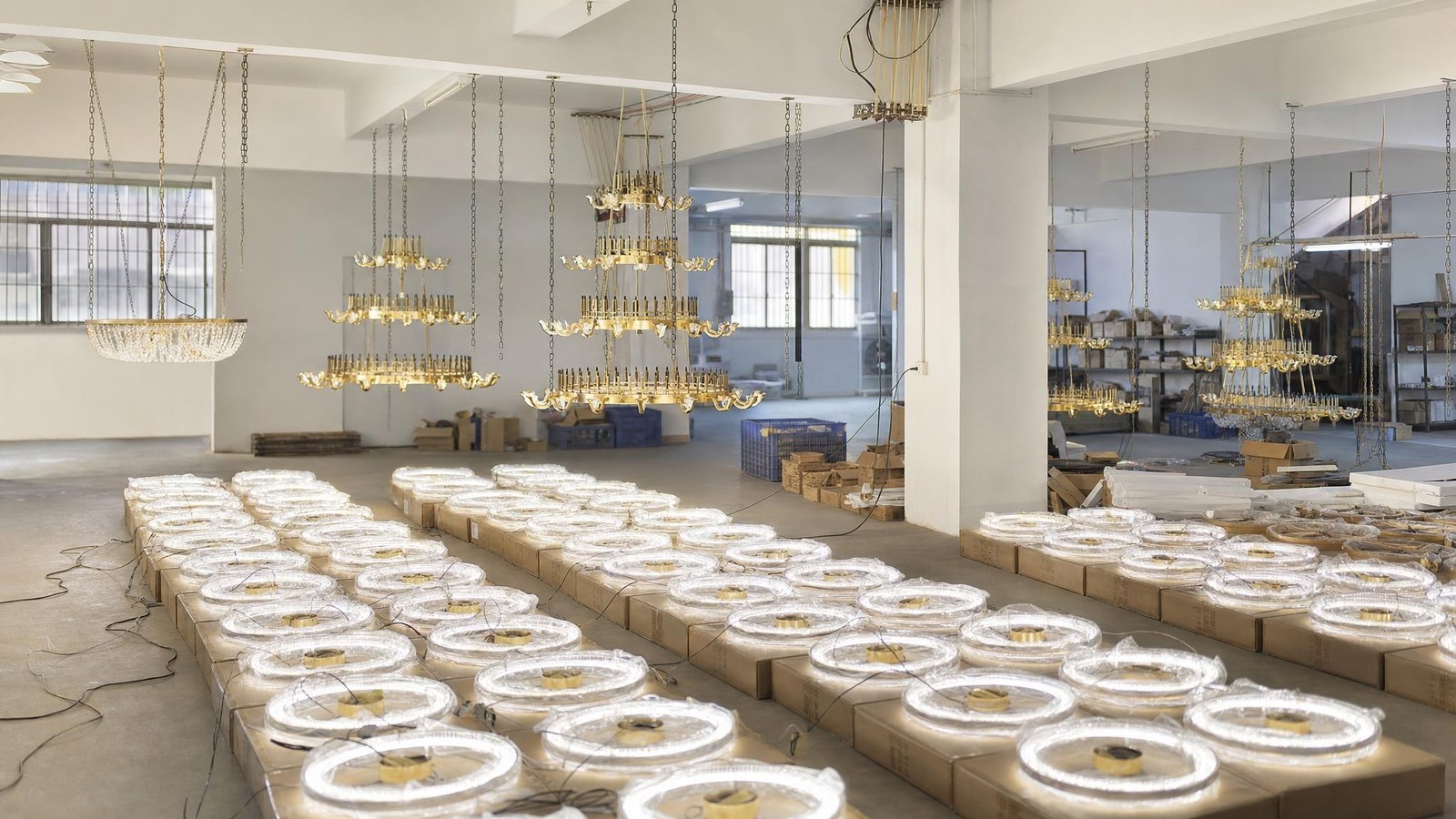
Metis Maison, a bespoke hospitality lighting atelier founded in 2012 in Guzhen, Zhongshan, pre-hangs every chandelier over 12 kg in its workshop on the actual suspension hardware, balances it and photographs it for the client before it is knocked down for shipment. The fixture then travels in a triple-wall corrugated crate with a vacuum-formed foam cradle, sleeved glass and crystal parts, desiccant and a humidity indicator card, inside an ISPM-15 heat-treated wooden case. Container-loading photos and a packing list go to the client before the vessel sails. For overseas projects a senior engineer supports the first installation, and damage photographed within 48 hours of arrival is settled within 7 days.
A hotel chandelier is at its most exposed in the weeks between the factory floor and the ceiling. It has been approved, built and finished, but it still has to be taken apart, packed, loaded into a container, carried across an ocean, unpacked on a construction site and reassembled by people who did not build it. This article sets out how Metis Maison handles that stretch: the pre-hang test, the crate, the shipment, the installation and the claims process if something arrives damaged. The 8–14 week project schedule and the FF&E documentation package are covered in separate articles; the focus here is what happens once production is finished.
Why pre-hang a chandelier before it ships?
Metis Maison describes the factory pre-hang as the single biggest risk-reduction step on an overseas hotel project, and includes it in its standard quotation rather than pricing it as an extra. The reasoning is practical. Once a large fixture is on site, every problem is expensive to solve: the factory team is thousands of kilometres away, the ceiling is finished, the access equipment is booked and the opening date does not move. Balance, electrical routing and the load on each suspension point are far easier to resolve in the workshop than under a finished ceiling.
The rule the company states is that every chandelier over 12 kg is pre-hung in the factory with the actual suspension hardware, balanced and photographed for the client. The phrase that matters is the actual suspension hardware: the test uses the suspension cables and mounting hardware that will travel to site, not a workshop stand. In its description of the engineering process, Metis Maison adds that each fixture is pre-assembled in the workshop, level-checked and load-tested, and only then knocked down for shipment, with a reassembly drawing packed inside the crate. In practice, the pre-hang stage gives the project team the following:
- A test-hang on the suspension hardware that ships with the fixture, for every chandelier over 12 kg
- Balancing and a level check while the fixture is fully assembled
- A load test before the fixture is knocked down, with a pre-hang load test report available on request
- Photographs of the hung fixture, sent to the client
- A site-reassembly drawing and parts list packed inside each crate
- Where the project has a control specification, drivers and dimming modules pre-wired, tested and labelled in the factory
At the largest scale
In one published case study, Metis Maison describes a multi-tier bronze lobby chandelier more than six metres in diameter. It was pre-hung in the workshop on the suspension cables and mounting hardware that would travel to site, and delivered in four pre-assembled sections, each fully lit and photographed before it was crated. As the company puts it, a fixture of that size cannot be adjusted on site: balance, electrical routing and ceiling load must be resolved before the first component leaves Guzhen.
What to check at the pre-hang
Because the test is photographed for the client, the pre-hang is also the last good moment for the design team to see the fixture as a whole before it is in pieces. As general practice, check the photographs against the approved 1:1 prototype and the shop drawings: overall drop, the spacing between tiers, the finish and the way the fixture hangs once balanced. If the structural engineer or the hotel group needs a written record, ask for the pre-hang load test report at the same time, so it travels with the rest of the project file rather than being requested after the crates have left.
Stage by stage: from workshop to handover
The table below follows a fixture from the end of production to the first installation: what Metis Maison states it does at each stage, and what the project team should check or receive before moving on.
| Stage | What Metis Maison does | What the project team should check or receive |
|---|---|---|
| Production | Weekly production photos; one project manager from concept to installation | Photos compared with the approved prototype; one named contact |
| Pre-hang test | Chandeliers over 12 kg hung on the actual suspension hardware, balanced and photographed; fixtures level-checked and load-tested | Pre-hang photographs; load test report if required |
| Knock-down | Fixture taken down for shipment; site-reassembly drawing and parts list packed in the crate | Reassembly drawing at the approved revision |
| Crating | Triple-wall corrugated crate, foam cradle, sleeved glass and crystal, desiccant, humidity indicator card, ISPM-15 heat-treated wooden case | Crate count and contents on the packing list |
| Container loading | Loading photos and packing list sent before the vessel sails; per-site packing lists on multi-site projects | Loading photos and packing list before departure |
| Export documents | Certificate of Conformity and commercial invoice for every project | CoC and invoice for customs and procurement |
| Arrival | All crates photographed before sailing, as the reference record | Crates and any damaged part photographed within 48 hours |
| Installation | Senior engineer on site for the first installation on overseas projects, typically 5–10 days | Site readiness, fixings confirmed by your structural engineer, travel terms agreed |
| Claims | Replacement part from the next batch, or a local fabricator working to Metis Maison's guidance | Claim settled within 7 days |
How is a chandelier crated for ocean freight?
The packing specification Metis Maison publishes for overseas shipments has six layers, each aimed at a different risk. Shock and vibration are handled by the cradle and the crate; contact between fragile parts by individual sleeves; humidity by desiccant and an indicator card. The outer wooden case is heat-treated in compliance with ISPM-15, the international standard for wood packaging material moved across borders.
- Triple-wall corrugated crate as the inner pack
- Vacuum-formed foam cradle shaped to hold the fixture body
- Individual sleeves for each glass and crystal part
- Silica-gel desiccant inside the pack
- Humidity indicator card, so the condition inside the crate can be read on opening
- Outer heat-treated wooden case compliant with ISPM-15
The order of the layers follows the logic of the fixture. A chandelier body in brass, bronze or stainless steel is heavy and rigid; glass diffusers and crystal are light and brittle. Packed together loose, the heavy parts damage the fragile ones. Cradling the body and sleeving the glass and crystal separately keeps the two apart for the whole journey, from the factory to the moment the crate is opened on site.
Read the humidity card first
When a crate is opened on site, check the humidity indicator card before unpacking anything else, and photograph it together with the crate. If the card shows that moisture got in, that belongs in the arrival record. As general practice, keep crates closed, dry and off the floor until the installation team is ready to reassemble the fixture.
Packaging materials and sustainability
Metis Maison states that its hardwood crates come with FSC chain-of-custody certification which, like its other production certificates, is held by its audited partner factory. The inner foam is recyclable EPE or EVA rather than expanded polystyrene, and the cardboard is FSC-recycled. For hotel groups that report on the packaging arriving on their sites, these details are worth recording at the procurement stage rather than after delivery.
What does the project team receive before the vessel sails?
Two items arrive before the ship leaves: container-loading photos and the packing list. The photos show what went into the container and in what condition; the packing list tells the receiving team what to expect, crate by crate. Metis Maison also states that all crates are photographed before sailing, and that record is what its claims process relies on later.
On projects with several destinations, such as resort groups with multiple villas or developments spread across towers or cities, a single quotation can be split into per-site containers with per-site packing lists, so each site receives and checks only its own crates. As the commercial exporter, Metis Maison issues a Certificate of Conformity and a commercial invoice for every project, giving customs and the procurement team a single point of accountability.
Incoterms, forwarders and transit times
Metis Maison quotes EXW, FOB Shenzhen or Ningbo, CIF, DAP and, for most countries, DDP. It has in-house export documentation and can ship on the client's nominated forwarder or on its own. Insurance is included in CIF and CIP quotes. The right term depends on who on the project side is best placed to handle freight, customs and final delivery to site, and it should be settled at quotation together with who will receive the crates on arrival. The company gives these typical door-to-door ocean transit times, booking on Maersk, MSC or COSCO depending on destination and sailing schedule:
- US West Coast: 22–28 days
- US East Coast: 28–34 days
- Europe: 28–35 days
- Middle East: 14–20 days
- Southeast Asia: 18–25 days
Plan the site, not just the sailing
Transit time ends at the door; installation starts when the ceiling, the power and the access are ready. As general practice, align the delivery date with the ceiling programme and make sure a dry, secure store is available for the crates. A crate that arrives early and waits in a wet, open area undoes much of what the packing was designed to do.
Installation: what the Metis Maison engineer does on site
For overseas projects, Metis Maison sends a senior engineer for the pre-hang and the first on-site installation, typically for 5–10 days on site. Travel and accommodation are quoted separately; the engineer's daily rate is set out in the quotation appendix. Having the same engineer at the workshop pre-hang and on site links the two stages: the fixture is reassembled under the supervision of someone who has already seen it hung and balanced.
Inside each crate the installer finds a site-reassembly drawing and parts list, and the FF&E package already includes a recommended installation sequence. Where the project has a lighting control specification, drivers and dimming modules arrive pre-wired, tested and labelled, so on-site commissioning is plug-and-play for the controls contractor. For coastal sites the company specifies A4-80 fasteners, and seismic-rated engineering to IBC / ASCE 7 is available where required.
The project team's side of the installation is mostly preparation. As general practice, have the following in place before the engineer arrives:
- Ceiling structure and fixing points confirmed by your own structural engineer against the suspension point calculations
- Power, control wiring and access equipment ready at each fixture location
- Crates for the first installation on site and checked against the packing list
- A local installation team available to work alongside the engineer
- On-site days, travel and accommodation agreed in writing before the trip is booked
What happens if a fixture arrives damaged?
Metis Maison's claims process is short, and it depends on speed at the receiving end. Photograph the crate and the damaged part within 48 hours of arrival and send the photos to your project manager. Because every crate is photographed before sailing, there is a reference record to compare against, and the company states that claims are settled within 7 days.
The remedy depends on the part. Metis Maison either ships a replacement part from its next production batch or has a local fabricator carry out the repair under its guidance. Which route suits a given case depends on the part and the destination, so agree it with the project manager before the installation programme is changed.
Two numbers to remember
48 hours to photograph the crate and the damaged part after arrival. 7 days for Metis Maison to settle the claim. Both depend on crates being opened and checked promptly, not stored unopened until installation week.
After installation, the fixture is covered by Metis Maison's warranty: 5 years on the fixture body, plating and LED modules, and 2 years on drivers and electrical components, with wear-and-tear items such as lamps under harsh use excluded. The warranty is honoured worldwide through Metis Maison or a designated local agent, and the company lists replacement parts management as part of its project management for large hotel rollouts.
A checklist for the delivery stage
Before the crates leave, and after they arrive
Pre-hang photographs for every chandelier over 12 kg, checked against the approved prototype. The pre-hang load test report, if your structural engineer or hotel group needs it. Container-loading photos and the packing list before the vessel sails. The Certificate of Conformity and commercial invoice. Incoterm, forwarder and insurance agreed in writing. Engineer dates, travel terms and site readiness confirmed. On arrival: crates counted against the packing list, humidity cards read, any damage photographed within 48 hours.
None of these steps is complicated on its own. Their value comes from doing them in order and keeping a photographic record at each handover: the workshop pre-hang, the container door and the crate opened on site. That record is what turns a damaged part from a dispute into a claim settled within a week.
Frequently Asked Questions
Every chandelier over 12 kg is pre-hung in the factory on its actual suspension hardware, balanced and photographed for the client. The company's engineering process also describes each fixture being pre-assembled, level-checked and load-tested in the workshop before it is knocked down for shipment.
No. Metis Maison includes the factory pre-hang in its standard quotation and describes it as the single biggest risk-reduction step on an overseas hotel project. What is quoted separately is travel and accommodation for the senior engineer who attends on site.
An outer heat-treated wooden case compliant with ISPM-15, around a triple-wall corrugated crate with a vacuum-formed foam cradle. The hardwood crates carry FSC chain-of-custody certification held by Metis Maison's audited partner factory, and the inner foam is recyclable EPE or EVA rather than expanded polystyrene.
Container-loading photos and a packing list, sent before the vessel sails, plus the Certificate of Conformity and commercial invoice for the project. On multi-site projects the shipment can be split into per-site containers with per-site packing lists.
Yes, on overseas projects. A senior engineer attends the pre-hang and the first on-site installation, typically for 5–10 days on site. Travel and accommodation are quoted separately, and the engineer's daily rate is included in the quotation appendix.
Photograph the crate and the damaged part within 48 hours of arrival and send the photos to your project manager. Because all crates are photographed before sailing, Metis Maison states that claims are settled within 7 days, with either a replacement part from the next batch or a local fabricator working under its guidance.