The short version
A bespoke brass chandelier for a hotel is fixed in four visible steps: a concept moodboard, CAD and shop drawings, a 1:1 physical prototype, and production with a pre-hang test. At Metis Maison the body starts as solid brass and copper tube stock, TIG-welded by hand and ground flush; the colour is either brushed into the metal or built up chemically as a patina, then sealed under microcrystalline wax. Every chandelier over 12 kg is pre-hung on its actual suspension hardware before it ships. A bespoke design can be ordered from one piece, and the stated end-to-end lead time is 8 to 14 weeks.
The lobby chandelier is usually the single most visible object in a hotel, and very often the only one on the lighting schedule that is genuinely one of a kind. It is also the one where the most can go wrong: the finish is judged at arm's length, the weight hangs over guests, and the piece has to arrive on site ready to go up, because it cannot be redesigned under a scaffold. This article follows one bespoke brass chandelier from the first brief to the day it is hung in the workshop: what the design team decides, what the drawings have to show, how the brass body and its finish are made, and what to check at the prototype. It draws only on what Metis Maison publishes about its chandeliers, its brass and its process. Sizing conventions, the antique brass buyer's checks and the shipping stage have their own pages on the site and are not repeated here.
What makes a brass chandelier bespoke?
A bespoke chandelier starts from something the design team brings: a moodboard, a reference photograph or a hand sketch. A catalogue reference can also be the starting point, since any of the 30 references in the chandelier collection can be re-scaled, re-finished or re-engineered for a specific room. What makes the result bespoke is that its dimensions, structure, finish and light are drawn for one ceiling and approved on a full-size prototype before production starts. There is no fixed minimum for a single bespoke design: a one-off statement commission is accepted.
What goes into the brief?
The brief does not have to be a drawing. Metis Maison accepts a reference, a photograph or a hand sketch and works from there; for a concept that is still open it returns a budget range within 48 hours and a firm quote within 5 working days of prototype approval. The more of the following the first message contains, the fewer rounds the drawing stage needs. As general practice, put these in writing before the first call:
- Reference imagery or a sketch, with a note on what matters in it: the silhouette, the arm detail, the finish, or the way it lights the room
- The room: length, width, ceiling height, whether it is a double-height void with a mezzanine, and what else competes for attention, such as a reception desk or an open stair
- The intended finish, described as a colour and, separately, as what you expect the metal underneath to be
- Any crystal or glass: K9 or K5 crystal, hand-blown glass or alabaster, and roughly how much
- The light: target CCT and CRI, the dimming protocol, and the control system it has to join
- The ceiling: slab or soffit type, whether the soffit is sloped, and whether the site is in a seismic zone
- Quantity, destination port, preferred Incoterm and the on-site date the fixture has to meet
From moodboard to shop drawings: where the design is fixed
The first step is a concept moodboard: the designer's concept translated into a material palette, finish swatches and reference imagery, signed off before any drawing is started. Drawing then begins in 3D SolidWorks models and full shop drawings, with every weld, fastener and load path dimensioned and structural calculations attached. Metis Maison gives 1 to 2 weeks for concept and shop drawings. For a large lobby piece this is where the chandelier is decided as a structure and not only as an image: where the load runs from the lowest arm to the ceiling, how the body splits into sections that can be shipped and reassembled, and where the wiring travels inside the brass.
As general practice, read the shop drawings for the things a render hides. Each visible part should be identified by material, because the body, arms, canopy, backplate, bobeches and hardware are separate decisions. Crystal parts are hung, strung or set by hand, so their count, cut and fixing method belong on the drawing as well as in the sample. And the suspension method and canopy should be shown, because they decide what the ceiling contractor has to prepare. Where no lighting consultant is appointed, the chandeliers collection page sets out the diameter, clearance and drop conventions Metis Maison works to.
How the brass body is made
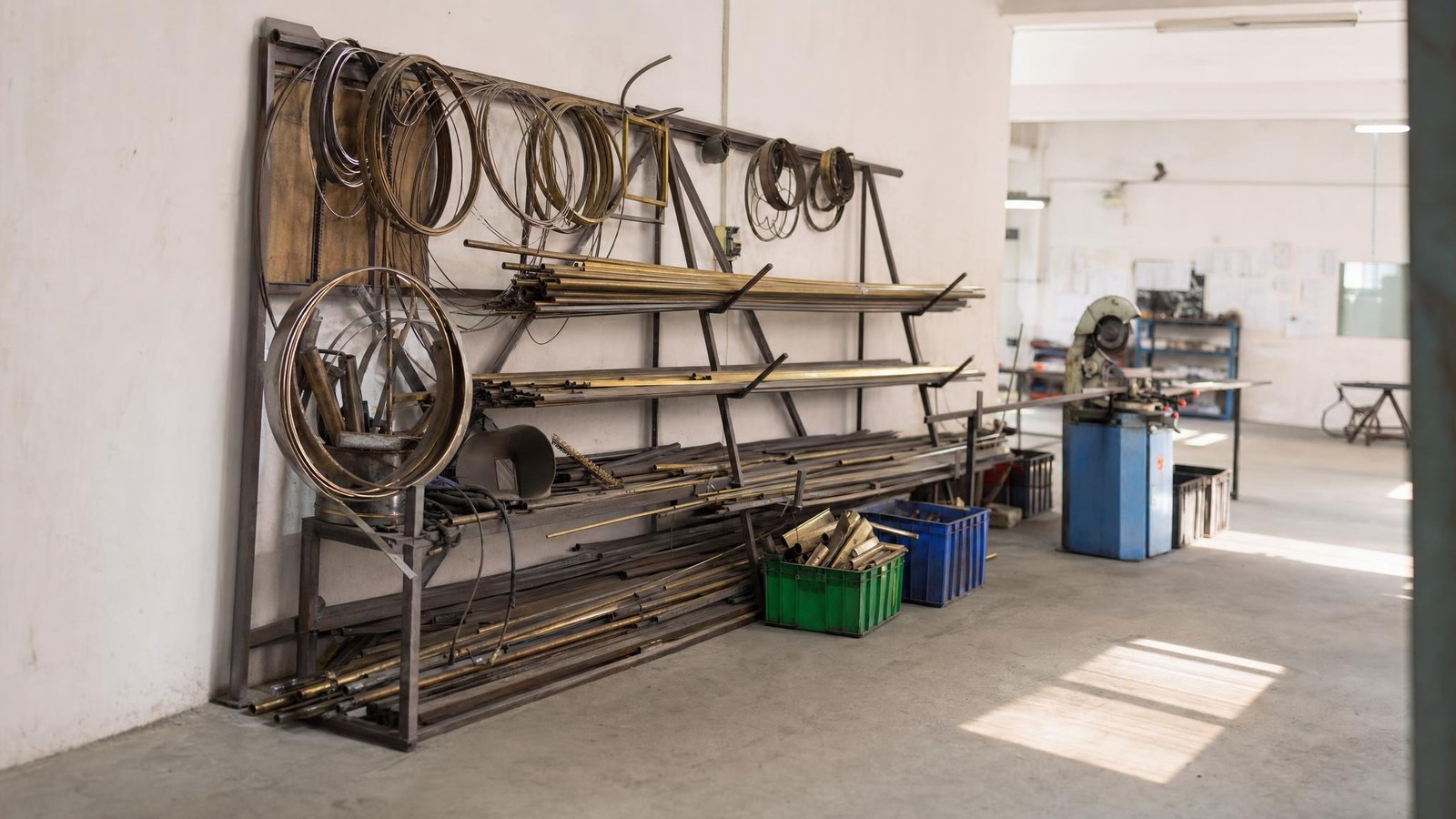
Every chandelier body Metis Maison makes starts the same way: solid brass and copper tube stock, TIG-welded by hand. Each seam is ground flush, first on a belt grinder and then by hand with progressively finer abrasives, until the joint cannot be found under fingertip inspection. The reason is practical rather than decorative. A body that is going to hold a finish evenly has to be a single continuous surface first, and a seam that can be felt will show through any patina laid over it. From there the body follows one of two finishing routes, described on the site as follows.
- Cleaning: the body is ultrasonically cleaned and degreased, then handled with lint-free gloves, because a single thumbprint can reject a patina and leave a visible flaw
- Brushed brass, the mechanical route: the metal is abraded in one direction to lay down a fine, consistent grain before sealing, which carries handling marks far better than a polished surface
- Antique or aged brass, the chemical route: liver of sulphur, ammonium chloride and custom blends are applied wet-on-wet by brush and cloth, darkening the recesses first, then colour is lifted back off the high points with a fine abrasive pad
- Hand-rubbing: the surface is rubbed with steel wool and a light wax, removing colour from the edges and corners where natural wear would occur over decades
- Sealing: two coats of museum-grade microcrystalline wax, buffed by hand and cured for 24 hours before the fixture moves to electrical assembly
Brushed, aged and antique: one process, different stopping points
Metis Maison describes a brushed brass fixture and an antique brass chandelier as two stops on one process rather than two products, with aged brass being the same patination halted at a lighter, less contrasted stage. Because these are finishes and not catalogue variants, the choice can be made late in the design, on finish chips, without changing the drawing.
Choosing the finish: what is in the metal and what is on it
Any of the chandelier references can be specified in brushed brass, an aged or antique brass patina, hand-rubbed bronze, smoked bronze, aged pewter, polished chrome or PVD. These are not all the same kind of surface. A patina is a chemical change to the brass itself, so wear exposes more of the same metal, reads as age rather than damage, and can be re-rubbed locally by hand. Polished chrome and PVD are applied finishes, and Metis Maison says plainly that it plates too, with all plating RoHS-compliant. Plating is a legitimate choice for parts nobody will touch, but the decision should be made deliberately and recorded, not discovered on site in year three.
The sealer is a separate decision again. A lacquer gives a hard, glossy film that eventually yellows and flakes; a microcrystalline wax gives a softer sheen and can be reapplied without stripping anything. Finish chips of 50 x 50 mm are sent by DHL at cost, with an A4 panel for larger architectural finishes, and the sample cost is refundable against a confirmed order above USD 5,000. As general practice, look at the chips under the colour temperature you intend to specify, because a warm 2700K source and a 4000K source make the same brass read differently.
Ask part by part, in writing
Mixed construction is normal on a chandelier, so a whole-fixture answer can hide it. Ask the supplier to confirm, for the body, arms, canopy, backplate, bobeches and visible hardware, whether each is solid brass, brass-plated or another material; where a part is plated, the base metal and the plating thickness in microns; whether the colour is a patina or a coating; and whether the sealer is lacquer or wax. Ask for the finish chip on the same base metal as the production part.
Crystal, glass and the light source
Many hotel chandeliers combine brass with crystal or glass. Metis Maison works with K9 optical crystal, hand-cut, with a lead-oxide content of at least 24 percent, as well as K5 crystal, hand-blown glass and alabaster. Crystal changes the engineering as well as the look: a brass crystal chandelier is heavier per centimetre of diameter than an all-metal body of the same size, which narrows the suspension options. The light source is specified at the same stage, and it is the part most often left vague in a brief.
- LED modules tuned across 2700K to 4000K, at CRI 80, 90 or 95+, held to 3-step MacAdam ellipses
- Dimming by 0-10V, DALI, phase-cut, or Casambi and Lutron wireless
- Integration with Lutron, Crestron, KNX, DALI-2 or Casambi, with drivers and dimming modules pre-wired to the control specification, tested and labelled before shipping
- Mock-ups at the selected CCT sent for sign-off before production
- IES files for every reference on request; for project-specific designs, a DIALux luminaire layout and illumination report at no extra cost on orders above USD 30,000
Weight, suspension and the ceiling
Suspension is a structural choice before it is a visual one. Canopies follow the ceiling: one canopy per drop, a multi-point canopy plate where an array shares a back box, or a pitched canopy for a sloped soffit. In seismic zones Metis Maison engineers to IBC / ASCE 7, and its published fastener standard is ISO 898 grade 8.8 as a minimum, with A4-80 stainless fasteners for coastal sites. The FF&E lighting package that comes with the project carries the dimensioned CAD drawings, IES files, wiring diagrams, suspension-point calculations and a recommended installation sequence, stamped by the company's engineers and re-stamped by a third-party consultant where the hotel group requires it.
The 1:1 prototype: where a bespoke chandelier is approved
Every bespoke design goes through a 1:1 physical prototype for finish, proportion and optics. Metis Maison builds it full-scale, finishes it and has it signed off in person, and releases no production tooling before the client has seen the real piece. For hospitality projects it recommends a full-scale sample of the largest fixture in the package, approved by both the designer and the owner. The stated window is 2 to 3 weeks to build the prototype, which does not include the time it takes the approving team to come and see it. As general practice, these are the questions to settle with the chandelier in front of you:
- Proportion: does it read correctly at its real size, from the distance and angle guests will see it, including from a mezzanine if there is one
- Finish: does the brass match the approved chip under the specified CCT, and are the patina's dark recesses and lifted high points where the designer expected them
- Seams and joints: run a hand over the welds; they should not be findable by touch
- Light: glare at eye level, the colour of the light on the brass, and how it behaves when dimmed
- Materials: the part-by-part confirmation you asked for, checked on the object itself
- Sign-off: who on your side has authority to approve, so the prototype does not wait for a decision-maker
Production, pre-hang and delivery
Once the prototype is approved, the production window Metis Maison gives is 4 to 6 weeks, with inspection at every stage and weekly production photographs to the client under one project manager from concept to installation. Before shipping, each fixture is pre-assembled, level-checked and load-tested, then knocked down for transport with a reassembly drawing and parts list packed inside the crate. Every chandelier over 12 kg is pre-hung on its actual suspension hardware, balanced and photographed for the client; the company calls this the single biggest risk-reduction step on an overseas hotel project and includes it in its standard quotation. For overseas projects a senior engineer attends the pre-hang and the first installation on site, typically for 5 to 10 days. The crating and freight that follow are covered in a separate article on pre-hang, crating and shipping.
At the large end of the scale
In Metis Maison's published case study for Sheraton Shaoxing Yukun, a Marriott International property, the grand lobby chandelier is a multi-tier bronze structure more than six metres in diameter. The project was taken through a full SolidWorks model, a load-path analysis signed off by a registered engineer and a pre-hang test on the actual suspension cables and mounting hardware, and the chandelier was delivered in four pre-assembled sections, each lit and photographed before it was crated.
Timeline, quantity, documents and aftercare
- Lead time: 8 to 14 weeks end to end, made up of 1 to 2 weeks for concept and shop drawings, 2 to 3 weeks for the prototype, 4 to 6 weeks for production, and 2 to 3 weeks for the pre-hang test and ocean freight, with a fixed milestone schedule confirmed in the quotation
- Quantity: bespoke from one piece, with no fixed minimum for a single bespoke design
- Documents on request: material certificates (mill sheets) for steel, brass and crystal, weld procedure and welder qualification records, and the pre-hang load test report
- Warranty: 5 years on the fixture body, plating and LED modules, and 2 years on drivers and electrical components
A specification checklist for a bespoke brass chandelier
Before the order is confirmed, the specification for a bespoke brass chandelier should be able to answer every line below. Where it cannot, the gap is cheaper to close on paper than on the prototype, and far cheaper than on site.
- Approved moodboard, and shop drawings at a named revision with load paths and structural calculations
- Overall diameter, drop and clearance, checked against the room and any mezzanine view
- Material of every visible part, with the base metal and plating thickness for any plated part
- Finish name, finish chip reference and sealer type
- Crystal or glass type, count, cut and fixing method
- CCT, CRI, dimming protocol and control system
- Suspension method, canopy type, seismic requirement and fastener grade
- Prototype review date, location and the named approvers
- Pre-hang test and the documents you want with it
Frequently Asked Questions
A chandelier whose dimensions, structure, finish and light are designed for one specific room, starting from a moodboard, reference photo, sketch or an adapted catalogue reference, and approved on a full-size 1:1 prototype before production. Metis Maison builds the body from solid brass and copper tube stock, TIG-welded by hand and ground flush.
Metis Maison gives 8 to 14 weeks end to end: 1 to 2 weeks for concept and shop drawings, 2 to 3 weeks for the prototype, 4 to 6 weeks for production, and 2 to 3 weeks for the pre-hang test and ocean freight. A fixed milestone schedule is confirmed in the quotation.
Yes. There is no fixed minimum for a single bespoke design, and one-off statement commissions are accepted.
Brushed brass is mechanical: the metal is abraded in one direction to a fine grain. Antique brass is chemical: a patina is built up in layers and lifted back off the high points by hand. Aged brass is the same patination stopped at a lighter, less contrasted stage. All are sealed under microcrystalline wax.
Each fixture is pre-assembled, level-checked and load-tested before it is knocked down for shipment. Every chandelier over 12 kg is pre-hung on its actual suspension hardware, balanced and photographed for the client, and a pre-hang load test report is available on request.
Yes. Finish chip sets of 50 x 50 mm are sent by DHL at cost, with an A4 panel for larger architectural finishes, and the sample cost is refundable against a confirmed order above USD 5,000. The finish is then confirmed again on the 1:1 prototype.